 Hint
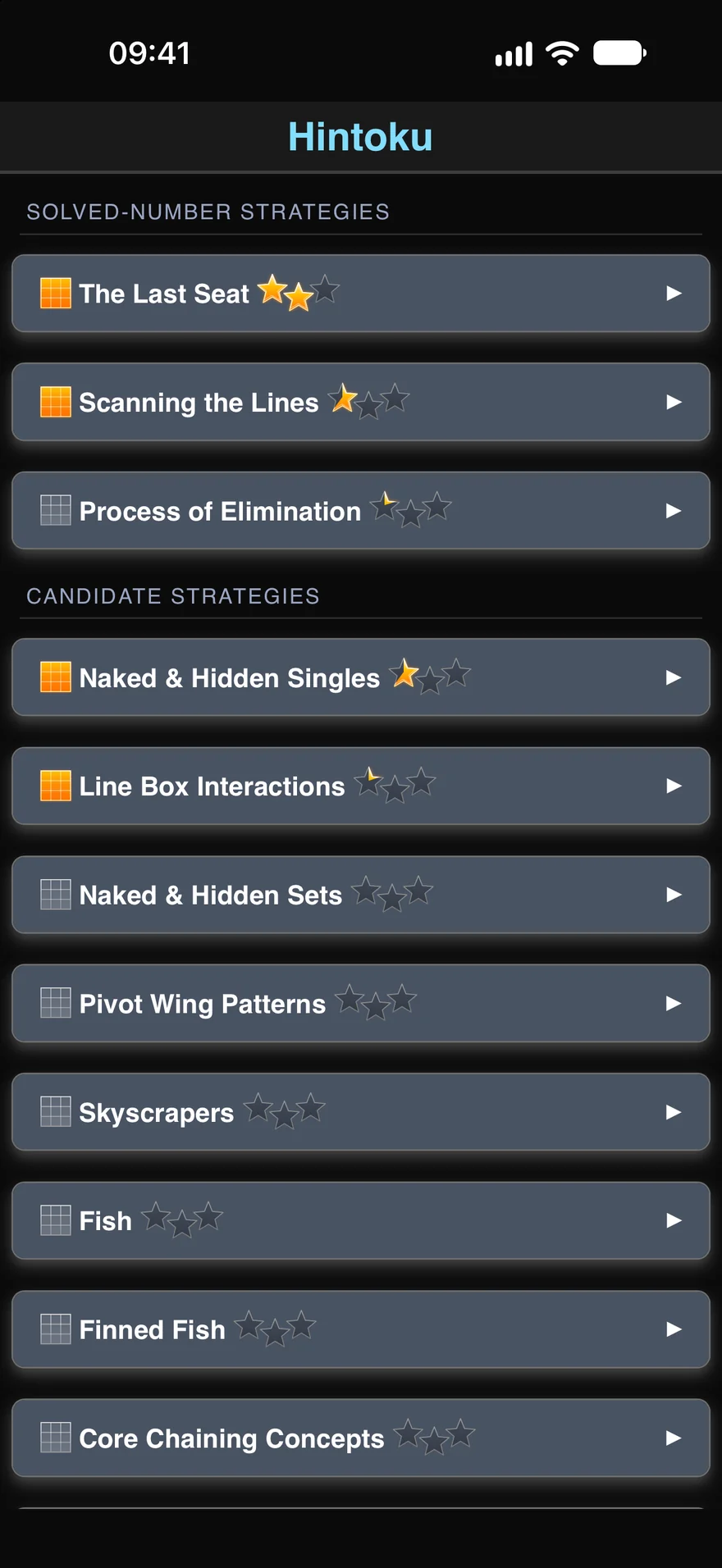
Sudoku strategies, in the order you should learn them
Sudoku never needs guessing. Every puzzle can be solved with logical techniques, and each technique builds on simpler ones. This is the order Hintoku teaches them in, with a difficulty from 0 (trivial) to 5 (advanced chains).
New to Sudoku? Start with the rules (7 short steps) →
Solved-number strategies
You solve these just by looking at the numbers already placed – no notes needed. They're where every Sudoku player starts, often without knowing the names.
- Full HouseDifficulty1the last empty cell in a row, column or box takes the one missing digit.
- Naked SingleDifficulty2a cell where every digit but one is already placed in its row, column or box.
Candidate strategies
Here you note the candidates – the digits each cell could still be. That makes the same logic easier to see and opens up patterns you can't hold in your head. New to candidates? Start with the candidates tutorial →
- Candidate EliminationDifficulty0once a digit is placed, remove it from the candidates of every cell that sees it.
- Naked SingleDifficulty1a cell with only one candidate left.
- Pointing NthDifficulty3a digit locked to one line inside a box – a Pointing Pair or Triple – clears it from the rest of that line.
- Box ReductionDifficulty3a digit locked to one box within a line clears it from the rest of that box.
- Naked NthDifficulty3N cells sharing N candidates – a Naked Pair, Triple or Quad – clear those digits from the rest of their row, column or box.
- XY-WingDifficulty4a pivot and two wings – three cells with two candidates each – that rule out a shared candidate.
- XYZ-WingDifficulty4an XY-Wing whose pivot also holds the third candidate.
- SkyscraperDifficulty4two lines where a digit fits only twice, with one end of each on a shared base.
- FishDifficulty4a digit locked to the same N columns in N rows – an X-Wing, Swordfish or Jellyfish.
- Finned FishDifficulty4a fish with an extra “fin” cell that still makes a few eliminations.
- 2-String Kite & CraneDifficulty4a short chain of “if… then…” steps on one digit, through a row, a column and a box.
- Empty RectangleDifficulty4a box where a digit fits only in one row and one column, combined with a line where it fits only twice.
- W-WingDifficulty4two cells with the same two candidates, tied together by a row, column or box.
- X-ChainDifficulty5a chain of “if… then…” steps on a single digit.
- XY-ChainDifficulty5a chain through cells with two candidates each.
- Forcing ChainDifficulty5a chain of “if… then…” steps that mixes digits, cells, rows, columns and boxes, with group nodes.
- ALS-XZDifficulty5two almost locked sets linked by a shared candidate that can't be in both.
- ColoringDifficulty5a digit's candidates in two alternating colours, to expose contradictions.
Up to XY-Chains, these patterns are realistic to spot by eye in normal play. The last levels are for enthusiasts who want to go deep.
Practice each one in Hintoku
Every strategy comes with interactive demos and puzzles that need it. When you get stuck, the hints show the strategy on your own board.