 Hint
Pointing Nth
Pointing Nth covers both the Pointing Pair and the Pointing Triple. When a digit's candidates inside a box – two of them or three – all lie in one row or column, the digit must go in that line within the box. So remove it from the rest of the row or column.
See it step by step
This is one of the walkthroughs from the Hintoku app – press play to step through it. More are waiting in the app, like Pointing Pair in a column and Pointing Triples.
New to candidates? Watch the candidates tutorial first →
How to spot it
- Pick a box and a digit that's still missing from it.
- Find the cells in the box where that digit is still a candidate.
- Do they all lie in one row or one column? Then the digit is "pointing" along that line.
- Remove the digit from the rest of that row or column – every cell outside the box.
Tip: in Hintoku, Spotlight makes this much faster – see below.
Pointing Nth in Hintoku
Spotlight shows you where each digit can still go, so you can check the board digit by digit:
- Tap a solved number to turn on Spotlight for that digit. Hintoku highlights every placed copy of it and every cell where it's still a candidate.
- Look for a box whose highlighted cells all lie in one row or one column – two of them make a Pointing Pair, three a Pointing Triple.
- Follow that line out of the box. If the digit is still highlighted in that row or column outside the box, those candidates can go. If not, move on – a box that lines up only helps when it points at something.
- Use the arrows below the hint panel to move Spotlight to the previous or next unsolved digit, and repeat.
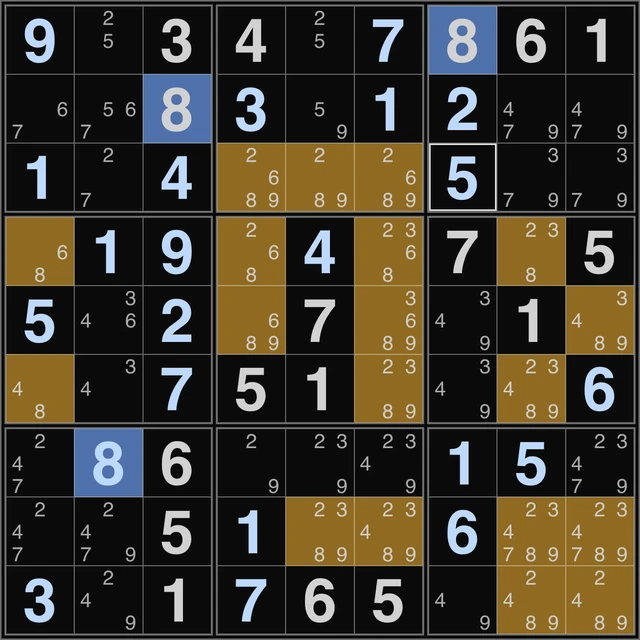
On this board, three boxes line up their 8s – but only one of them removes anything:
- Box 2 (top middle): the 8s lie only in row 3 – a Pointing Triple. But row 3 has no other 8s, so nothing goes.
- Box 4 (middle left): the 8s lie only in column 1. Column 1 has no other 8s either.
- Box 8 (bottom middle): the 8s lie only in row 8 – and row 8 still has two 8s in box 9. Those two 8s can be removed.
Pointing Nth FAQ
What is Pointing Nth?
It's one strategy that covers both the Pointing Pair and the Pointing Triple. Inside a box, a digit can still go in two cells (a pair) or three cells (a triple) – and they all lie in the same row or column. Whichever cell it ends up in, the digit will be in that line, so you can remove it from the line outside the box.
Pointing Pair or Pointing Triple – what's the difference?
Only the number of cells. With two candidate cells in the line it's a Pointing Pair, with three a Pointing Triple. The logic is exactly the same, so Hintoku teaches them as one strategy, Pointing Nth – the N stands for the number of cells.
How hard is Pointing Nth?
Hintoku rates it difficulty 3. It's the first strategy that doesn't place a number – it only removes candidates, which then lead to the next single. Hintoku teaches it in level 5, Line Box Interactions, together with Box Reduction.
Can I use it without candidates?
Yes. If all the places in a box where a digit can still go lie in one row or column, the same logic works with placed numbers only – the second walkthrough shows it. Without candidates you can't write the removal down, so you use it straight away: here the 6 is pushed out of row 2 outside the top-middle box, which leaves column 9 with a single place for the 6. Hintoku teaches this No-Candidate Logic version in the same level 5, Line Box Interactions.
How is it different from Box Reduction?
It's the mirror image. Pointing Nth starts from a box and clears the rest of a line. Box Reduction starts from a line: if a digit's candidates in a row or column all sit in one box, it clears the rest of that box.
Practise Pointing Nth in Hintoku
Puzzles built around Pointing Nth, with hints that walk you through it on your own board.
- All walkthroughs free
- First 10 puzzles of this level free
- One payment unlocks all 7,500
- No ads, no subscription